
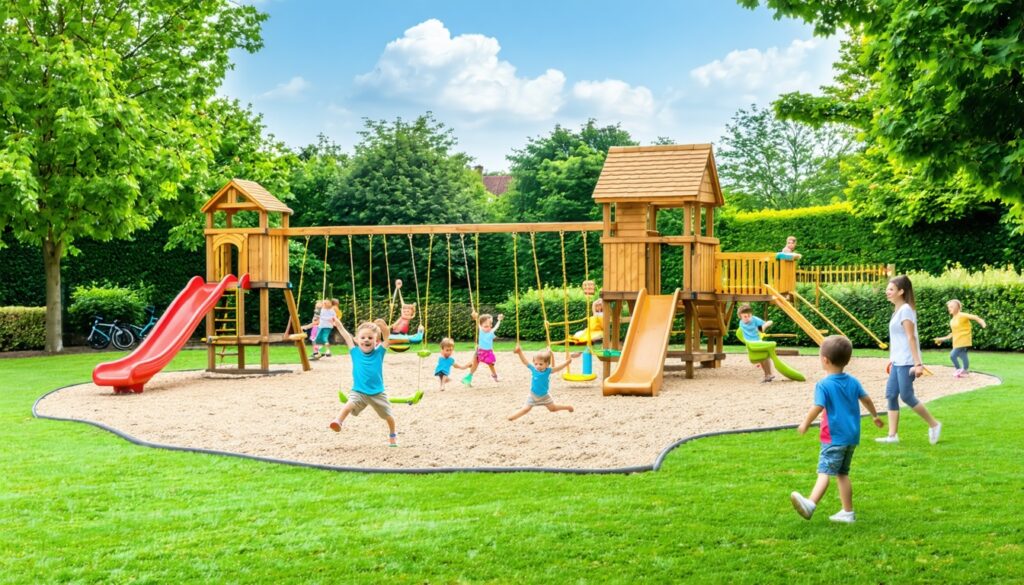
Ensuring your playground markings comply with playground safety regulations UK is vital for protecting children and meeting legal standards. BS EN 1177 defines how well surfaces absorb impact from falls (covering heights from 0.6 m up to 3.0 m). Good news, this audit is simpler than it sounds. You can confirm compliance by reviewing substrate type, installation quality, surface performance and educational design features in a few focused steps.
A brief walk-through of base layers, application methods, slip testing and layout will show if you meet the standard.
Understand BS EN 1177 requirements
BS EN 1177 focuses on critical fall heights (CFH) and shock-absorbing performance to reduce injury risk. You’ll want to match your surface to the expected CFH under swings, slides or climbing frames.
Impact attenuation criteria
The standard uses a head-form drop test to measure how much energy the surface absorbs. Look for a test report showing your CFH rating (for example 1.5 m or 2.0 m) on each play zone.
Base layer depth and material
Your thermoplastic markings must sit on an impact-absorbing layer such as bonded rubber or loose-fill. Verify the installed depth aligns with your CFH rating (for instance 40 mm of bonded rubber for a 2.0 m CFH). If you need clarity on substrate specs, refer to our thermoplastic marking installation guide.
Audit installation quality
A compliant playground surface starts with proper planning and precise application. Skipping prep or fixing steps can compromise safety.
Conduct a site survey
Walk your playground to note slope, drainage and wear zones. You’ll want to identify cracks or low spots under tarmac (these can affect impact tests). A free site survey can help you spot hidden issues before installation.
Follow expert installation steps
Thermoplastic is applied in thin layers using controlled heat. Installers check bond strength, temperature and line accuracy as they work. Proper curing ensures your markings won’t lift or crack under use.
Verify durability and resistance
Thermoplastic markings stand out for long-term performance, but you should still check key properties on site.
Non-slip performance
Play areas get wet, so textured finishes matter. Many schools choose anti-slip thermoplastic safety coatings for consistent grip. You can run a simple pendulum test to verify slip resistance.
UV and environmental endurance
Sunlight can fade or weaken some materials. Look for uv resistant thermoplastic playgrounds rated for outdoor use. Typical guarantees span up to 10 years (Project Playgrounds offers a decade-long warranty on markings subject to surface condition). You can also compare expected service life on our thermoplastic lifespan UK page.
Compare thermoplastic vs painted lines
Thermoplastic generally outperforms paint when it comes to safety and upkeep. The table below highlights key differences.
| Feature | Thermoplastic marking | Painted line |
|---|---|---|
| Durability | 5–10 years guarantee | 1–2 years before retouch |
| Slip resistance | High (non-slip finish) | Variable, often lower |
| Compliance support | Designed for BS EN 1177 surfaces | Not certified |
| Maintenance | Low – occasional cleaning | High – frequent repainting |
| Customisation | Complex shapes, colours and educational graphics | Limited by stencils |
Good news, lower maintenance means fewer disruptions to playtime.
Integrate educational and brand features
Beyond safety, your markings can boost learning and school spirit.
Embed learning concepts
Create counting trails, hopscotch grids or map-based games with outdoor learning thermoplastic markings. For inclusive play, explore inclusive playground surface markings that welcome every child.
Add branding and themed zones
Carry school colours or mascots into play areas using thermoplastic playground branding. You can also design themed playground zones for nature, science or art themes. Browse our thermoplastic playground marking ideas for inspiration.
Quick audit checklist
- Verify CFH rating under BS EN 1177
- Confirm base-layer type and depth
- Inspect bond strength and line precision
- Test slip resistance in wet conditions
- Review UV performance and colour stability
Next steps
A compliant, engaging playground surface protects children and reflects well on your school. You’ve got this, and the process is more straightforward than it may seem. If you’d like expert support, Project Playgrounds has helped over 1,500 schools across the UK and Europe with free site surveys, custom designs and professional installation. Reach out today to transform your playground into a safe, stimulating environment.