
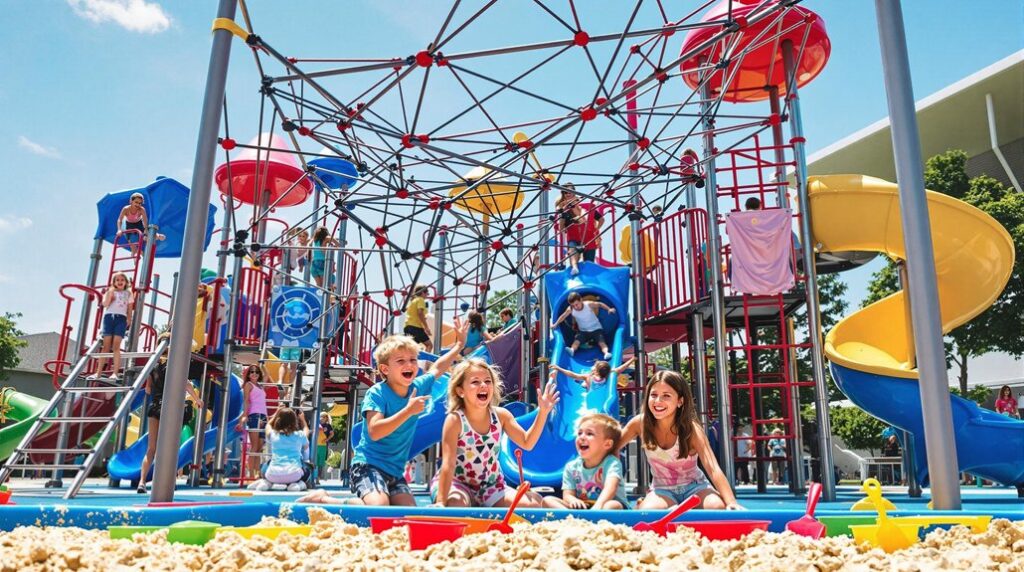
When selecting playground equipment for 10 to 12-year-olds, focus on structures that encourage physical activity and social interaction. Options like climbing walls, monkey bars, and innovative swing sets promote strength, coordination, and teamwork. Safety features such as impact-absorbing surfaces and weight limits are essential. Incorporating elements for cooperative play fosters engagement among peers. Regular maintenance guarantees these structures remain safe and functional. Explore further to uncover innovative designs and best practices for maximizing your playground’s impact.
Age-Appropriate Equipment for Preteens
When selecting age-appropriate equipment for preteens, it’s essential to take into account the developmental needs and interests of children aged 10 to 12. This age group thrives on complex play structures that challenge their problem-solving skills and coordination, such as multi-level towers and obstacle courses. Incorporating unscripted play elements, like spinners and rotating platforms, allows for creative exploration. Physical challenges should include equipment that tests balance and strength, such as rope walks and overhead ladders. Additionally, integrating socialization features, like partnered seesaws and group swings, encourages cooperative play. Finally, using age segmentation through tiered challenges accommodates varying abilities, ensuring all children remain engaged and active, fostering physical and social development effectively. Furthermore, durable playground markings can enhance these play areas, providing structured environments that support active play and engagement.
Climbing Walls: Challenges for Older Kids
Climbing walls offer a unique blend of physical and mental challenges that cater specifically to older kids, as they seek more demanding activities that push their limits. Constructed from durable materials like wood and steel, these walls guarantee safety and longevity. With features such as padded landing surfaces and secure handholds, the design prioritizes user security. Climbing walls also present varying difficulty levels, promoting engagement across different skill sets. As children navigate these challenges, they develop muscle strength, coordination, and spatial awareness. Additionally, the climbing experience fosters social interaction and teamwork, enhancing cognitive skills through problem-solving. Overall, climbing walls not only provide physical benefits but also serve as a platform for personal achievement and imaginative play. Furthermore, incorporating thermoplastic playground markings in the surrounding area can enhance safety and define play zones for children.
Swing Sets: Safety and Design Features
Swing sets serve as a pivotal component of outdoor play for children aged 10 to 12, offering not only entertainment but also opportunities for physical development and social interaction. When selecting swing sets, consider materials like cedar or redwood for their natural decay resistance, while metal should be treated to prevent rust. Confirm structural integrity by adhering to specified weight limits and using interlocking joints for stability. Incorporate safety features such as rubber-coated chains to avoid pinch points and hidden bolts to minimize cuts. Additionally, choose impact-absorbing surfaces like rubber mulch or engineered wood fiber for fall protection. A modular design enhances functionality, allowing customization with trapeze rings and other integrated elements for varied play experiences. Furthermore, utilizing child safe thermoplastic in playground markings can enhance the overall safety and vibrancy of the play area.
Monkey Bars: Building Strength and Agility
Monkey bars stand out as a fundamental piece of playground equipment, specifically designed to foster physical development in children aged 10 to 12. They effectively build upper body strength by engaging muscles in the shoulders, arms, back, and chest, which enhances overall muscle endurance. Regular use of monkey bars promotes coordination and agility, requiring precise movements that improve balance. The skills acquired here translate well into various sports and activities, supporting broader physical fitness. Additionally, monkey bars create opportunities for social interaction, allowing children to collaborate and encourage one another. This dynamic environment fosters not only physical but also mental resilience, as overcoming challenges on the bars boosts self-confidence and emotional well-being, making them an essential addition to any playground. Furthermore, the use of durable thermoplastic materials in playground equipment ensures they can withstand heavy use, providing lasting enjoyment for children.
See-Saws: Encouraging Balance and Cooperation
While many playground activities focus on individual skills, seesaws uniquely promote balance and cooperation among children aged 10 to 12. Engaging with seesaws enhances physical development by improving balance, coordination, and muscle strength through dynamic movement. As you push off the ground, you simultaneously refine both fine and gross motor skills, contributing to overall fitness. Cognitively, seesaws teach cause-and-effect principles and develop spatial awareness, while also enhancing problem-solving abilities through the necessity of balancing with a partner. Socially, they foster teamwork and communication skills, promoting empathy as children learn to reflect on each other’s experiences. Finally, the rhythmic motion of seesaws offers emotional benefits, including stress relief and a sense of accomplishment, making them an essential addition to any playground.
Zip Lines: Thrilling Adventures for Active Play
As children move into the pre-adolescent age group, the appeal of more exhilarating playground experiences becomes evident. Zip lines, such as the ZipKrooz® and GameTime SkyRun Zip Track, offer thrilling rides that enhance physical development. The two-way functionality allows continuous play, while molded bucket seats with safety harnesses guarantee inclusivity for all users. Rubber-wrapped chains provide stability, complemented by built-in elevation designs that boost speed. With modular bays enabling side-by-side racing, social interaction flourishes as kids engage in friendly competition. These zip lines support vestibular system development and core strength enhancement through dynamic movement. Age-appropriate design considerations, including weight limits and ergonomic seating, make zip lines a suitable choice for active play among 10 to 12-year-olds.
Safety Considerations for Older Children
Guaranteeing safety on playgrounds designed for older children involves a multifaceted approach that addresses equipment selection, design, supervision, and injury prevention. You should prioritize climbing structures and challenging equipment that not only enhance physical skills but also stimulate cognitive abilities. Incorporate larger swings and taller slides for excitement and activity. Design separate zones for different age groups, guaranteeing adequate fall zones with impact-absorbing materials. Supervision is essential; adults need to monitor play to prevent unsafe behavior and educate children on proper equipment usage. Implement safety features, such as secure railings and soft landing surfaces, to reduce fall risks. Regularly monitor play areas for hazards and guarantee emergency protocols are in place for prompt responses to accidents. Additionally, incorporating playground markings can help create organized play zones and enhance safety by clearly delineating different activity areas.
Maintenance and Inspection of Playground Equipment
Regular maintenance and inspection of playground equipment are essential for guaranteeing the safety and longevity of play structures designed for 10-12-year-olds. Daily visual inspections help identify immediate hazards, while weekly checks address wear and tear. Monthly examinations should be thorough, and quarterly inspections ascertain compliance with safety standards. Annual inspections by certified professionals guarantee that equipment meets regulations. Immediate repairs of damaged parts and the replacement of worn components are critical to prevent accidents. Regular cleaning and sanitizing reduce germ spread, while lubricating moving parts prevents rust. Additionally, verifying that surfacing materials meet depth standards and comply with ASTM F2373 is fundamental for cushioning effectiveness. Maintaining detailed records of inspections and training personnel enhances overall safety and reliability.
Innovative Designs for Modern Playgrounds
The evolution of playground design has shifted toward creating engaging, innovative environments that cater to the needs of children aged 10 to 12. Modern playgrounds now feature climbing structures with varied difficulty levels, net climbers accommodating over 100 children for social interaction, and treehouse-inspired platforms that stimulate imaginative play. Inclusive spinners allow collaboration among children with diverse abilities, while themed environments sustain engagement through storytelling. Sensory elements, like interactive panels and musical equipment, promote cognitive development. Additionally, technology trends such as motion-activated lighting and app-connected play enhance the experience. Incorporating risk-benefit features, such as zip lines and dynamic spinners, guarantees physical challenges that foster strength and agility, making these spaces dynamic and multifaceted for older children. Furthermore, the use of high-quality thermoplastic materials in playground markings ensures a durable and vibrant play environment that can withstand heavy usage.
Promoting Cooperative Play and Supervision
Promoting cooperative play and effective supervision is essential in modern playgrounds, as it not only enhances children’s social skills but also guarantees a safe and engaging environment. Trained supervisors actively monitor interactions, fostering teamwork through clear behavior expectations. Implementing rotation systems for equipment encourages group participation, while assigning supervisor zones ensures full coverage for rapid conflict resolution. Multi-user structures, like seesaws and team swings, require coordinated movement, promoting collaboration. Additionally, open-ended components and cooperative games facilitate structured challenges. Supervisors must employ mediation techniques for disputes, supported by visual guides for proper equipment use. Regular play refresher sessions reinforce cooperative expectations, creating a culture of teamwork. This thorough approach lays a foundation for positive interactions and safe play dynamics.